
Why Must Christians Go Through Many Tribulations? | Acts 14
Sermon: “Acceptance & Opposition” · Acts 14 · Preached February 1, 2026 by Eric Love
The Courage to Go Back
This past Sunday, our evangelist Eric Love preached through Acts 14. By Acts 14:21, Paul and Barnabas had reached Derbe. They’d been stoned, beaten, driven from city to city, and finally they’d made many disciples in Derbe. Look at a map of their journey, and you’ll notice something striking: they were geographically closer to their sending church in Antioch than they’d been in weeks. The logical move—the safe move—would have been to head straight home.
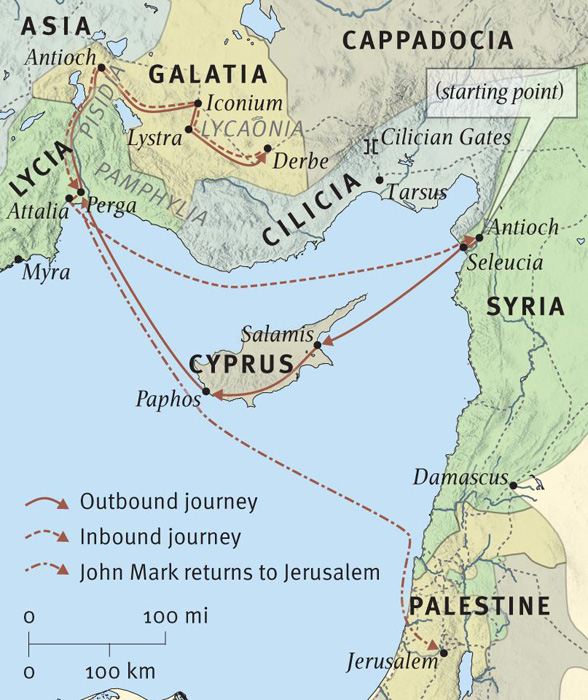
Instead, they turned around.
They reversed course and walked directly back into the face of the persecution they’d been fleeing. Back to Lystra, where Paul had been stoned and left for dead. Back to Iconium, where the crowds had plotted to stone them. Back to Antioch of Pisidia, where they’d been violently expelled from the city. Why would anyone do this?
Because the gospel doesn’t just save individuals—it establishes churches. And Paul and Barnabas understood that healthy, functioning local churches were essential to continue the mission after they left the region. Their return journey wasn’t recklessness. It was strategic conviction about the power of the gospel proclamation and the necessity of establishing elders and strengthening disciples in every church they’d planted.
The Secret of Their Success
Eric began the message by highlighting the question every preacher wants to know: What caused so many people to believe when Paul and Barnabas preached in Iconium? Acts 14:1 says they “spoke in such a manner that a large number of people believed, both of Jews and of Greeks.”
The answer isn’t found in rhetorical skill or persuasive technique. Verse 3 reveals their secret: “They spent a long time there speaking boldly with reliance upon the Lord, who was testifying to the word of His grace, granting that signs and wonders be done by their hands.”
Reliance. Complete, uncompromising reliance on the Lord.
Paul and Barnabas weren’t trusting in themselves. They weren’t operating from a place of self-confidence or human ability. They were utterly dependent on Christ to work through them. And the Lord testified to their message by performing miracles that authenticated the gospel and demonstrated God’s approval of the risen Jesus.
This challenges those of us who minister in any capacity. Do we rely on our preparation, our gifting, our experience? Or do we genuinely depend moment by moment on the power of Christ working through us? As Eric reminded us from 1 Corinthians 15:10, Paul could say, “I labored… yet not I, but the grace of God with me.” It’s both/and. We labor faithfully, but God gets the credit because He’s the one producing the fruit.
Miracles That Demand a Verdict
One of Eric’s most compelling points was how Luke presents miracle accounts in Acts. These weren’t vague legends or stories that grew with time. Luke recorded them with specific, verifiable details that invite investigation.
Consider the healing in Lystra: “A man was sitting who had no strength in his feet, lame from his mother’s womb, who had never walked” (Acts 14:8). That level of detail matters. This wasn’t a minor ailment or a psychosomatic condition. This was a man who had never walked—not even once. And when Paul commanded him to stand, he immediately leaped up and began walking.
Eric pointed out three crucial elements in how Luke records these miracles:
First, the miracles were remarkable and undeniable. They couldn’t be dismissed as natural phenomena or coincidences. People lame from birth don’t spontaneously develop the ability to walk.
Second, the miracles were witnessed by many people—including enemies of Christianity. Luke practically invites readers to verify the accounts by interviewing eyewitnesses. He even includes names of people who were healed, making investigation easier.
Third, the miracles were done in Jesus’ name. If Jesus had been a false messiah, God would never have allowed miracles to be performed in His name. The continued miraculous authentication proved God’s approval of Jesus and the truth of the gospel message.
As Eric said, “We believe these things not because we’re gullible people. We believe these things because there’s good reason to.”
The Horror of Misdirected Worship
After Paul healed the lame man in Lystra, the crowds erupted. “The gods have become like men and have come down to us!” they shouted in their local dialect. They called Barnabas “Zeus” and Paul “Hermes,” and the priest of Zeus brought oxen to offer sacrifices to them.
This was Paul and Barnabas’ chance. If they wanted recognition, authority, or adoration from men—this was it on a silver platter. They could have soaked it in.
Instead, they were horrified.
They tore their robes—a sign of extreme distress—and rushed into the crowd crying out: “Men, why are you doing these things? We are also men of the same nature as you!” Eric emphasized that their reaction reveals everything about their motives. They had no desire for personal glory. Their entire ministry was about exalting Christ and redirecting all worship to Him alone.
Eric shared a recent experience where someone compared our church’s benevolence ministry to “angels sent from God.” His response was perfect: “Listen, the reason we do this is because Jesus told us to. If Jesus didn’t tell us to do this, honestly, I’m not driving all over the place helping people this way. We do this because Jesus is our Lord.”
It’s all about Him. That’s the end of the story.
Every act of service, every instance of generosity, every good work—it all points back to Christ. We’re simply reflecting His character and obeying His commands. The glory belongs to Him alone.
Through Many Tribulations
Perhaps the most sobering section of Eric’s message dealt with Acts 14:22: “Through many tribulations we must enter the kingdom of God.”
Must. Not “might.” Not “could possibly.” Must.
Why is tribulation inevitable for Christians? Eric offered four possibilities:
Persecution is the natural consequence of living faithfully in a fallen world. Jesus said if we follow Him, we will be persecuted. The world didn’t accept Him, and it won’t fully accept us either.
Tribulation has a purifying effect on our souls. When life is comfortable, our true character remains dormant. But suffering brings who we really are to the surface, allowing us to honestly evaluate ourselves and grow.
Tribulation tests the genuineness of our faith. Faith can only be truly exercised when there’s reason and opportunity to do otherwise. Trials reveal whether our faith is real or merely cultural.
Tribulation causes us to long for heaven. Pain reminds us that we can’t find ultimate peace and rest in this world. It redirects our focus toward God and the world to come.
As Eric said, “God loves us too much to leave us in our comfort, because that’s a very dangerous thing. A life that’s always comfortable is a dangerous, dangerous life.”
That’s a hard truth. But it’s a necessary one.
The Geography of Conviction
Coming back to the map: when you see how close Paul and Barnabas were to home in Acts 14:21, their decision to return becomes even more remarkable. They could have justified going home. They’d preached the gospel, made disciples, faced severe persecution. Mission accomplished, right?
But they understood something we often miss: the mission isn’t complete until churches are established and strengthened. So they went back through every dangerous city, “strengthening the souls of the disciples, encouraging them to continue in the faith” (Acts 14:22), and appointing elders in every church (Acts 14:23).
This wasn’t a missionary journey in the casual sense. This was strategic, intentional church planting—establishing healthy, functioning local bodies of believers who could continue advancing the gospel long after the apostles moved on.
Their confidence wasn’t in their own courage. It was in two things: the power of the gospel they’d proclaimed, and the importance of establishing churches that would remain faithful to that gospel.
Where Does This Leave Us?
Here are some questions Eric’s message forced me to wrestle with:
Am I truly relying on the Lord, or am I operating in my own strength?
It’s easy to pray before ministry and then functionally depend on our own preparation, skill, or experience. True reliance means moment-by-moment dependence on Christ’s power, not just a prayer at the beginning.
How do I respond when God doesn’t receive the glory He deserves?
When people compliment our work, our service, our ministry—do we subtly accept the praise, or do we immediately and naturally redirect it to Christ? Paul and Barnabas tore their robes at the thought of being worshiped. Does misdirected glory disturb us that much?
Am I viewing tribulation as an enemy or as a tool God uses for my good?
We instinctively avoid suffering. But what if God is using present difficulties to purify my character, test my faith, or cause me to long more deeply for Him?
Do I have the same conviction about the local church that Paul and Barnabas demonstrated?
Would I be willing to walk back into danger to strengthen believers and establish healthy church leadership? Do I see the local church as essential to God’s mission, or just as one option among many?
The Grace of God Working Through Us
Paul’s words in 1 Corinthians 15:10 capture the entire message: “But by the grace of God I am what I am, and His grace toward me did not prove vain, but I labored even more than all of them, yet not I, but the grace of God with me.”
I labored. Yet not I.
We have genuine responsibility. We must be faithful. We must work. But whatever fruit we bear, whatever we accomplish for the kingdom—God gets the credit. He’s the one working in us and through us to accomplish His purposes.
This should encourage us deeply. We don’t have to rely on our flawed, limited selves. The pressure isn’t on us to produce results. We plant the seed. We water it. But God causes the growth. Whether in evangelism, personal sanctification, growing in love, or overcoming sin—we rely completely on His power.
Paul and Barnabas faced acceptance and opposition, miracles and stonings, worship and persecution. Through it all, they kept their eyes fixed on Christ, their confidence rooted in His power, and their mission focused on establishing His church.
May we do the same.
Listen to the full sermon here: Acceptance & Opposition – Acts 14
Preached February 1, 2026 at Howell Bible Church
This is part 22 of our series in Acts. Previous: Why Do Religious People Reject the Gospel?. Browse the whole series: Acts & Paul’s Letters.
Discover more from Howell Bible Church
Subscribe to get the latest posts sent to your email.


