When Having Three Priorities Means Having None: Lessons from the Early Church on Spiritual Focus
What if the secret to spiritual fruitfulness isn’t doing more, but doing less with greater focus?
In Acts 1:12-26, we find the early church in a moment of waiting. Jesus has ascended to heaven, leaving His followers with a clear command: wait in Jerusalem for the Holy Spirit, then be My witnesses to the ends of the earth. What they do next offers a masterclass in spiritual prioritization that challenges our modern tendency to pile our plates high with endless activities.
The Paradox of Priorities
There’s a saying that cuts through our busy culture like a knife: “If you have three priorities, you really have no priorities.” By definition, a priority is that which is more important than everything else. When we claim multiple “top” priorities, we’ve created an impossibility. What happens when those priorities conflict? How do we choose between them?
The early church understood something we often miss: clarity brings freedom. The freedom to say yes to what matters most means the freedom to say no to everything else—even good things.
Unity Born from Singular Focus
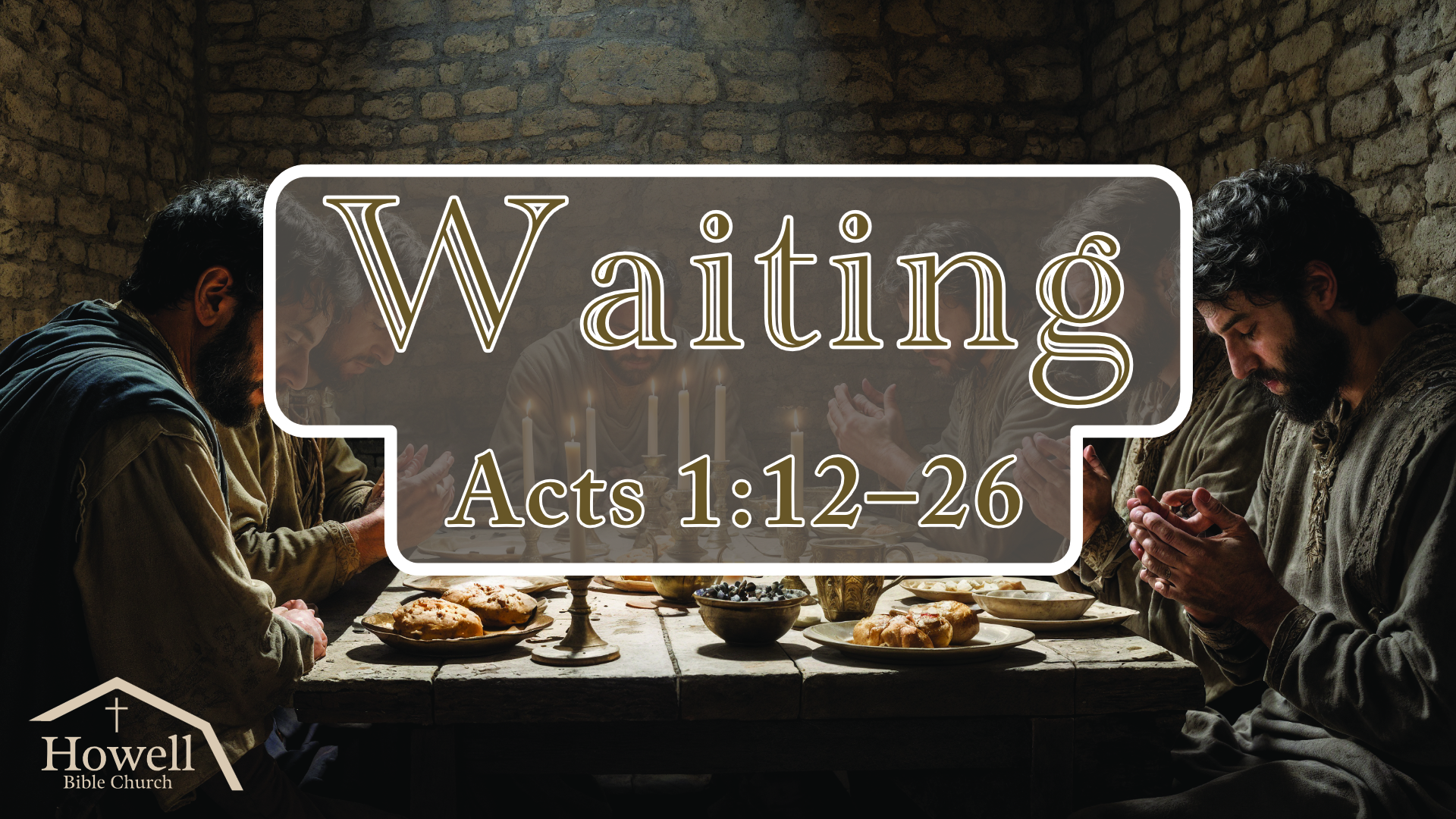
After watching Jesus ascend, the disciples returned to Jerusalem—a short Sabbath day’s journey—and gathered in an upper room. Luke tells us something remarkable about this group of about 120 believers: “These all with one mind were continually devoting themselves to prayer” (Acts 1:14).
This wasn’t just the eleven remaining apostles. Mary the mother of Jesus was there. The women who had followed Jesus were there. Even Jesus’s brothers—who the Gospels tell us had been skeptical during his ministry—were now present as believers. What changed their minds? Their brother had been executed and then came back to life. That tends to shift perspectives.
But notice what unified this diverse group: they shared one mind, one focus, continually devoted to prayer while they waited. They weren’t filling their time with busywork or creating programs to feel productive. They were waiting on the Lord with laser-like focus on the mission He’d given them.
The Necessity of Scripture
When Peter stands to address the group about replacing Judas, he doesn’t share his personal vision or strategic plan. He immediately drives their attention to Scripture, using a powerful word: “the Scripture had to be fulfilled” (Acts 1:16). Not “should be” or “might be”—but had to be.
Peter quotes from Psalms 69 and 109, passages Jesus Himself had likely taught them during His forty days of post-resurrection appearances. This wasn’t creative interpretation; this was apostolic understanding given by Christ Himself. The foundation they were building required twelve apostles, and that office needed to be filled.
The criteria were specific: the replacement must be someone who had accompanied them throughout Jesus’s entire ministry, from John’s baptism to the ascension. This person would “become a witness with us of His resurrection” (Acts 1:22).
The Unchanging Mission
Here’s where the passage speaks most powerfully to our modern situation. The early church’s singular priority was to be witnesses—witnesses of Christ’s suffering, death, resurrection, and offer of forgiveness to all nations. This wasn’t one priority among many; it was the priority that gave meaning to everything else.
Today, we’re tempted to redefine success by worldly metrics. We celebrate churches that run like successful businesses, measure impact by attendance figures, and sometimes soft-pedal the gospel to avoid closing doors. But the moment a church thinks its goal is to increase attendance rather than witness to God’s glory, it ceases to be a church. The moment a Christian organization drops Jesus’s name to dig more wells or feed more hungry people, it becomes just another humanitarian effort.
The difference between a Christian organization providing clean water and an atheistic one doing the same thing should be obvious: one does it explicitly in Jesus’s name, bearing witness to his love and redemption.
What About Casting Lots?
The selection of Matthias through casting lots might seem strange to modern readers. Yet Proverbs 16:33 reminds us, “The lot is cast into the lap, but its every decision is from the Lord.” This wasn’t superstition; it was submission. They had two qualified candidates and trusted God to reveal His choice.
Significantly, this is the last time we see lots cast in Scripture. After Pentecost, when the Holy Spirit comes, the church has different means of discerning God’s will. But the principle remains: when we’ve done our due diligence, when we’ve sought God in prayer and Scripture, sometimes we must simply trust Him to guide our decisions.
The Challenge for Today
As we examine our own lives, we must ask: Have we become like people at Thanksgiving, trying to pile everything possible onto our plates? Have we allowed secondary priorities to crowd out our primary calling as witnesses?
Christians can have different ministries and spheres of influence. We don’t all do the same activities. But whatever our specific calling, it must include Christian witness. The accountant, the teacher, the parent, the retiree—all are called to bear testimony to Christ in their unique contexts.
Some will witness at evangelistic events, others at abortion clinics or community fairs. But if not there, then where? How are you participating in this unchanging mission that Christ initiated and the apostles gave their lives to establish?
A Prayer for Clarity
If you’ve found yourself distracted, overwhelmed, or unclear about your spiritual priorities, take heart. The same God who guided the early church still guides His people today. The priority hasn’t changed: we are called to be witnesses of Christ’s death and resurrection, proclaiming repentance and forgiveness in His name.
Perhaps it’s time to clear the plate, to focus on the one thing necessary, to join that early church in being “of one mind, continually devoting ourselves to prayer” as we wait on God and prepare to be His witnesses.
Listen to the full sermon on Acts 1:12-26 here for a deeper exploration of these themes and their application to your spiritual journey.
Questions for Reflection:
- What competing “priorities” have crowded out your witness for Christ?
- How can you cultivate the same unified, prayerful waiting we see in the early church?
- In your specific context and calling, what would it look like to be an intentional witness for Jesus?
 Howell Bible Church