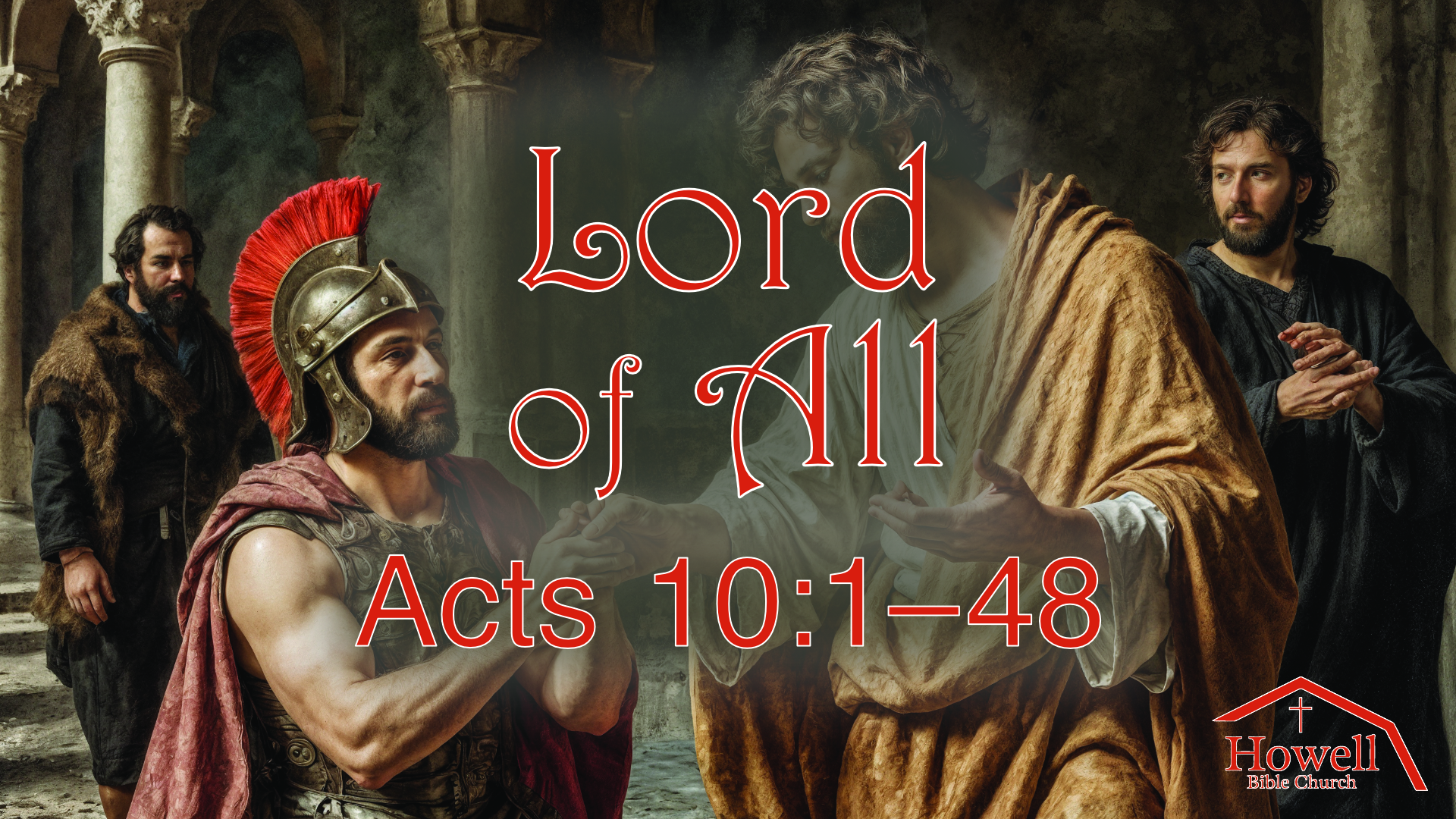
Lord of All


When the World is More Eager Than the Church

Have you ever noticed how sometimes the people we assume aren’t interested in God turn out to be the most spiritually hungry? We make excuses—”If they wanted to know about God, they’d come to church” or “The information is out there; it’s in their court now.” But what if our assumptions are wrong? What if the world is actually more eager to receive the gospel than we are to proclaim it?

That’s exactly what we discover in Acts 10, one of the most pivotal chapters in human history. This is the moment when God officially opens the door for the gospel to go to the Gentile world. Without this door swinging wide open, the gospel never would have reached people like us. But here’s the striking reality in this passage: Cornelius the centurion was far more ready to hear about Jesus than Peter was to tell him.

This passage confronts us with an uncomfortable truth about our own hesitancy to cross barriers, our reluctance to share what we’ve freely received, and our tendency to underestimate how hungry people really are for the truth.

The Eager Seeker Who Had Everything but Jesus

Cornelius wasn’t your average Roman centurion. Scripture paints a picture of a man who was devout, prayerful, generous, and God-fearing. He gave alms to the Jewish people. He prayed continually. He had drawn as near to the God of Israel as a Gentile could without becoming a full convert. By all appearances, this was a deeply spiritual man.

But here’s what we must understand: sincerity is not enough for salvation. Interest in spiritual things is not enough. Even having a god that you worship is not enough. Cornelius needed to hear about Jesus. He needed the gospel. Without it, despite all his devotion and good works, his sins remained unforgiven.

God knew this. So He sent an angel to appear to Cornelius with very specific instructions: “Send to Joppa and ask for Simon, who is also called Peter. Bring him here.” And what did Cornelius do? He immediately obeyed. He sent his servants. And then, while he waited for this preacher to arrive, he gathered everyone he could—his relatives, his close friends, his household—and said, “You need to hear this message too.”

Imagine that kind of spiritual hunger. Cornelius didn’t even know what message he was going to hear, but he filled his house with people to listen.

The Reluctant Messenger Who Said “No, Lord”

Meanwhile, Peter was on a rooftop, praying and physically hungry. And that’s when God gave him a vision—a dramatic, repeated, impossible-to-ignore vision. A sheet came down from heaven filled with all kinds of animals, and a voice said, “Get up, Peter, kill and eat.”

Peter’s response? “By no means, Lord, for I have never eaten anything unholy and unclean.”

Let that sink in. Peter said “No” to the Lord. And God had to repeat this vision three times before Peter would even begin to consider what God was showing him. Jesus had already declared all foods clean back in Mark 7, but Peter was still clinging to his traditions, his upbringing, his comfort zone.

This wasn’t really about food, though. The food laws had been given to make Israel a separate, distinct people—set apart for God’s purposes. But now that the Messiah had come, those barriers were being torn down. God was saying, “What I have called clean, no longer call unclean.” And He wasn’t just talking about bacon and shellfish. He was talking about people.

Even after the vision, Peter was confused. But then—perfectly orchestrated by God—the men sent by Cornelius arrived at his door. The Spirit spoke to Peter: “Go with them without misgivings, for I have sent them myself.”

Continue reading

Peter’s Healing Ministry

When God’s Power Does the Heavy Lifting: Reflections on Peter’s Healing Ministry

Have you ever walked away from a conversation about faith feeling like a failure? You stumbled over your words. You couldn’t remember that perfect response you’d rehearsed. The person walked away unconvinced, and you were left wondering if you’d done more harm than good.

If that’s ever been you, this past Sunday’s message was exactly what you needed to hear.

Evangelist Eric Love continued our journey through the book of Acts, bringing us to chapter 9, verses 32-43. What unfolded wasn’t just a lesson in biblical history—it was a recalibration of how we think about our role in sharing the gospel.

The Church Was Born for Mission

Eric opened by reminding us of the big picture. The book of Acts records the explosive growth of the early church in the thirty years following Christ’s resurrection. And Acts 1:8 serves as the thesis statement for everything that follows: “You will receive power when the Holy Spirit has come upon you, and you shall be My witnesses in Jerusalem, in all Judea and Samaria, and to the ends of the earth.”

Here’s what struck me: those words were spoken directly to the apostles, yet they were fulfilled by the entire church. When persecution scattered believers throughout Judea, Galilee, and Samaria, it wasn’t just the apostles preaching. Ordinary Christians carried the gospel wherever they went, planting churches and seeing thousands come to faith.

The Great Commission wasn’t meant for a select few. It belongs to all of us.

No Magic Tricks Here

In Lydda, Peter encountered a man named Aeneas who had been paralyzed and bedridden for eight years. Eric made an important observation: the miracles recorded in Scripture weren’t cheap illusions performed for gullible crowds. These were verifiable, severe conditions healed instantly and publicly.

You can’t fake blindness from birth. You can’t pretend to be lame for a lifetime.

Jesus healed a man born blind in John 9. Peter had previously healed a man lame from his mother’s womb in Acts 3. And now, Aeneas—eight years paralyzed—rises immediately at Peter’s word. These weren’t pulled rabbits or guessed cards. These were undeniable acts of God performed in plain sight, leaving witnesses with only one conclusion: this power comes from somewhere beyond human ability.

Continue reading

A Chosen Instrument


A Chosen Instrument

Reflections on Acts 9:1-31

Everyone was afraid of him.

That’s the situation in Acts 9:26. Saul of Tarsus — the man who had been breathing out threats and murder against the church, the man who had dragged men and women off to prison, the man who had cast his vote against Christians when they were being put to death — this man shows up in Jerusalem claiming to be a disciple. And believers are skeptical of him.

Can you blame them? This wasn’t just someone with a rough past. This was the greatest enemy the early church had ever known. His reputation preceded him by hundreds of miles. When Ananias in Damascus received a vision telling him to go to Saul, his immediate response was essentially, “Lord, are you sure? I’ve heard about this guy” (Acts 9:13-14).

So, when Saul arrives in Jerusalem wanting to associate with the disciples, the fear is understandable. The hesitation makes sense. But if that’s where the story ended — if everyone had simply kept their distance — the history of the church would look very different.

Enter Barnabas.

The Man Who Stepped Forward

Verse 27 tells us that Barnabas “took hold of him and brought him to the apostles.” While everyone else hung back, one man stepped forward. He vouched for Saul. He explained how Saul had seen the Lord on the road, how Jesus had spoken to him, how he had been preaching boldly in Damascus.

Here’s what makes Barnabas’s action so remarkable: unlike Ananias, Barnabas didn’t receive a divine vision commanding him to do this. No angel appeared. No voice from heaven. He simply saw what God had done in Saul’s life and had the courage to act on it.

This is the Barnabas moment — and it’s a moment the church still needs today.

Continue reading

The Mission Continues

The Mission Continues: When God Orchestrates Divine Appointments

Have you ever experienced a moment so perfectly timed that you couldn’t help but see God’s hand in it? A conversation that started exactly when someone needed to hear truth? A question asked just as you had the answer?

We live in a hyper-connected world where information travels instantly, yet countless people around us have never truly heard the gospel. Despite Bibles on every shelf, sermons streaming online, and churches on every corner, there are neighbors in our own county who don’t know Jesus Christ. If this was true in our digital age, imagine the early church—no internet, no printing press, no mass communication—yet the gospel spread like wildfire.

How did they do it? Acts 8:25-40 reveals a pattern that’s as relevant today as it was 2,000 years ago.

From Revival to the Road

Peter and John had just witnessed an incredible move of God among the Samaritans. After confirming that Philip’s ministry was genuine and that the Holy Spirit was truly at work, they headed back to Jerusalem. But they didn’t waste the journey—they preached the gospel to many Samaritan villages along the way.

This wasn’t casual conversation. The text says they “solemnly testified and spoke the word of the Lord.” That phrase carries weight. This wasn’t feel-good, surface-level talk. They understood they were speaking about matters of eternal life and death. The gospel is good news precisely because, without it, we remain under God’s wrath. That’s a heavy testimony, and they treated it with the seriousness it deserved.

Meanwhile, Philip continued his ministry. But God had other plans—plans that would take him from revival crowds to a single conversation on a desert road.

Continue reading

The Gift of God


The Gift of God – Acts 8:5-24 | Howell Bible Church


The Gift of God

Have you ever avoided someone because bridging that gap just seemed too difficult? Maybe it’s a coworker with opposing political views, a neighbor from a different background, or even a family member you’ve written off as “too far gone.” We all have people or places we’d rather avoid.

But what if God is calling you to cross that barrier?

In Acts 8, we witness one of the most dramatic cultural crossings in the early church. Philip, a Jewish believer fleeing persecution in Jerusalem, does the unthinkable: he goes to Samaria and preaches Christ. To grasp the weight of this moment, you need to understand that Jews and Samaritans despised each other with a hatred spanning centuries. Jews would literally travel miles out of their way to avoid passing through Samaritan territory. These weren’t just unfriendly neighbors—they were considered half-breeds, religious heretics, enemies.

Yet Philip goes. And when he does, something extraordinary happens.

When God’s Power Crosses Human Barriers

Philip didn’t sneak into Samaria to hide. He proclaimed Christ openly, and the crowds gave attention to what he said as they heard and saw the signs he was performing. Demons were cast out with loud shouts. The paralyzed walked. The lame were healed. The text tells us there was “much rejoicing in that city.”

Picture that scene for a moment. A Jewish preacher proclaiming a Jewish Messiah to a people who had been taught to hate Jews—and instead of rejection, there’s citywide celebration. This is the power of the gospel to demolish walls many thought were permanent.

Philip’s message was simple but profound: he preached the Kingdom of God and the name of Jesus Christ. He wasn’t offering self-help tips or cultural commentary. He was proclaiming that the long-awaited King had come, that His name was Jesus, and that anyone—even despised Samaritans—could enter His kingdom through repentance and faith.

Men and women believed. They were baptized. They publicly identified with this King and His kingdom. The barrier that had stood for generations crumbled in the face of resurrection power.

Continue reading

The Fruit of Devotion

The Fruit of Devotion: When Witness Becomes Costly | Howell Bible Church

The Fruit of Devotion: When Witness Becomes Costly

What would it take for you to stop talking about Jesus? A threat to your reputation? Your job? Your life?

In Acts 6-8, we encounter Stephen—a man who understood something profound about Christian identity that we’ve largely forgotten. When we call him the first Christian martyr, we miss the revolutionary truth: the word “martyr” simply means “witness.” Stephen wasn’t exceptional because he died; he was faithful because he understood what every believer is called to be.

This Sunday, we explored how Stephen’s story isn’t about one extraordinary man’s sacrifice—it’s about God’s pattern for advancing His kingdom through faithful witnesses who count the cost and speak anyway.

The True Meaning of Being a Witness

When Jesus declared in Acts 1:8, “You will be my witnesses,” He literally said, “You will be my martyrs.” This wasn’t a call to an elite group of super-Christians. This was—and is—the fundamental calling of every believer.

Stephen grasped this completely. Full of grace and power, he performed signs and wonders among the people. When religious leaders couldn’t refute his wisdom, they resorted to false accusations, dragging him before the Sanhedrin. They accused him of blasphemy against Moses and the temple—serious charges that warranted death.

But notice Stephen’s response. He didn’t defend himself or try to negotiate his way out. Instead, he seized the opportunity to bear witness to Christ. With his life hanging in the balance, Stephen chose proclamation over preservation.

The Pattern of Rejection and Faithfulness

Stephen’s lengthy sermon before the Sanhedrin wasn’t just a history lesson—it was a prophetic indictment. He traced through Israel’s history, showing a consistent pattern: God sends deliverers, and His people reject them.

Abraham left everything to follow God’s promise. Joseph was sold into slavery by his own brothers. Moses was rejected by the very people he came to rescue, with them saying, “Who made you a ruler and judge over us?” The prophets were persecuted and killed by those who should have received their message.

Stephen’s point was devastating in its clarity: “You are doing just as your fathers did.” The religious leaders who prided themselves on preserving Moses’ law and honoring the prophets were actually following in the footsteps of those who rejected God’s messengers. And ultimately, they had murdered the Righteous One—Jesus Christ—whom all the prophets had announced.

Continue reading

When Problems Arise


What the Early Church Teaches Us About Healthy Conflict Resolution

Have you ever noticed how quickly people assume something must be wrong when a church talks about problems? I remember preaching through Acts years ago and coming to this same passage about the early church’s first internal conflict. Afterward, multiple people pulled me aside, lowered their voices, and asked, “So what’s really going on?”

Nothing was going on. We were just preaching through the book of Acts.

But that reaction reveals something important about how we think about church health. We’ve somehow convinced ourselves that a healthy church is one without problems. The reality? Church health isn’t measured by the absence of problems—it’s measured by how faithfully we handle problems when they arise.

And they will arise.

The Problem Nobody Saw Coming

Acts 6 opens with a jarring phrase: “Now at this time, while the disciples were increasing in number, a complaint arose.” Notice the timing. This wasn’t happening during a low point. The church was thriving. People were being added daily. The Word was spreading. The apostles had just been flogged for preaching Jesus and had rejoiced in their suffering.

Everything was going remarkably well.

And then came the complaint.

The Hellenistic Jews—those who had adopted more Greek culture and customs—accused the church of neglecting their widows in the daily food distribution. Meanwhile, the native Hebrew widows were being cared for. This wasn’t a minor logistical hiccup. The word Luke uses for “complaint” is the same word the Septuagint uses to describe the Israelites murmuring against Moses in the wilderness. This was serious grumbling that threatened to fracture the unity of the early church.

Here’s what makes this so significant: this division existed before the church even began. The cultural divide between Hellenistic and Hebrew Jews was real and deep. When these groups came to faith in Christ, there was beautiful unity. But growth, logistical challenges, and limited resources began to expose fault lines that were always there.

The tension was real. The complaint was legitimate. And if left unaddressed, vulnerable widows would suffer.

The Response That Changed Everything

What the apostles did next is stunning. They called the entire congregation together—no closed-door meetings, no damage control—and said something that might sound shocking at first: “It is not desirable for us to neglect the Word of God in order to serve tables.”

Wait, what? Were they too prideful to help? Too busy with “important” ministry?

Not at all.

Continue reading

The Whole Message


The Whole Message: When Faithfulness Costs Everything | Howell Bible Church


The Whole Message: When Faithfulness Costs Everything

A reflection on Acts 5:12-42


The Cost of Following Jesus

Following Jesus costs something. Sometimes it costs everything.

This isn’t a popular message in our comfort-driven culture, but it’s the reality that every believer must eventually face. The question isn’t if faithfulness will cost us something, but rather: Is Jesus worth that cost?

In Acts 5, the early church confronts this question head-on. Fresh off miraculous signs and explosive growth, the apostles find themselves arrested, imprisoned, and eventually flogged for preaching about Jesus. Their response? They rejoiced.

Arrested for Preaching the Gospel

The scene in Acts 5:12-16 shows a thriving church. Signs and wonders are happening. Multitudes are being added daily. People are streaming in from surrounding cities to be healed. Everything looks like success by any metric we’d use today.

But then opposition strikes.

The religious authorities, filled with jealous zeal for their own traditions, arrest the apostles and throw them in jail. This isn’t their first arrest—it’s becoming a pattern. The message of Jesus threatens the status quo, and those in power want it silenced.

Then something remarkable happens: an angel opens the prison doors and delivers a stunning command.

Continue reading

Heart & Soul


Heart and Soul: Why the Early Church Changed the World (And We Don’t)

A look at Acts 4:32-5:11 and the price of authentic Christianity

What’s the difference between a church that changes the world and a church that’s just playing church? Between spiritual power that turns communities upside down and religious activity that merely keeps people busy?

These aren’t comfortable questions, but they’re essential ones—especially when we compare the early church’s impact to our modern reality.

Continue reading

Authority

This past Sunday, Greg Churchley delivered a challenging message from Acts 4:5-31 that confronted us with a fundamental question every believer must answer: When human authority conflicts with God’s authority, where will we stand?

The Confrontation

The scene Greg painted was intimidating. Peter and John had healed a lame beggar and preached the resurrection of Jesus in the temple. Now they stood in the center of a room surrounded by every person of power in Jerusalem—the entire Sanhedrin, the high priest, the scribes, the elders. This wasn’t a casual conversation. This was the equivalent of being called to testify before Congress, except these men held both civil and religious power over Israel.

Their question cut to the heart of the matter: “By what power or in what name have you done this?”

It’s the same question that echoes through all of human history when sinful humanity encounters God’s truth. As Greg pointed out, this is the question behind the serpent’s hiss in Genesis 3: “Has God really said?” It’s the question the Pharisees asked when Jesus cleared the temple. It’s always been about authority.

Continue reading