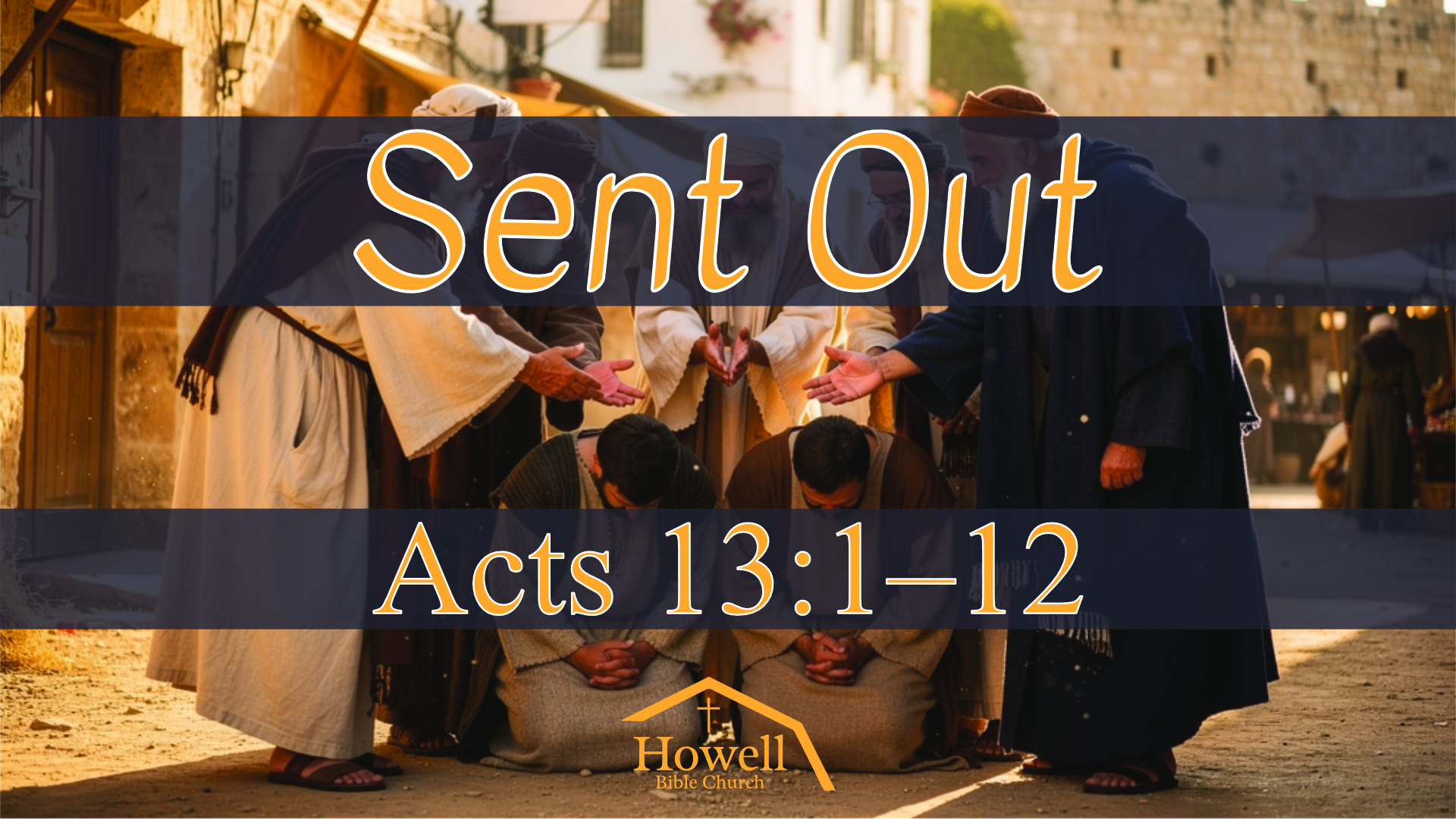
Sent Out


When God Interrupts the Good to Call You to the Greater

We live in a culture obsessed with optimization. GPS routes us around traffic. Apps deliver groceries to our doorstep. We can accomplish in hours what once took days. And somewhere along the way, we’ve internalized a dangerous assumption: if there’s an easier path, we should take it.

But what if following Jesus actually requires the opposite of optimization? What if the path of discipleship sometimes leads away from comfort and toward something harder—something that looks less like upgrading your life and more like disrupting it? The church at Antioch was about to find out.

In Acts 13, we encounter a thriving community of believers doing everything right. Five gifted leaders were ministering to the Lord. The gospel was advancing. Then the Holy Spirit spoke: “Set apart for me Barnabas and Saul for the work to which I have called them.” God was asking them to release 40% of their leadership team. No explanation. No guarantee of easy replacements. Just an invitation to obedience that would cost them something precious.

Ministering to the Lord, Not Just Managing a Ministry

The text tells us something crucial about what was happening in Antioch: “While they were ministering to the Lord and fasting, the Holy Spirit said…” This phrase, “ministering to the Lord,” is transformative. This isn’t language about programs or services or even ministry to people. This is about worship.

Many approach church the way we approach everything else in our convenience-driven culture: as consumers. We church shop. We evaluate features and benefits. We ask, “What’s in it for me?” But the believers in Antioch gathered with a radically different question: How can we bring honor and glory to God?

They weren’t asking, “Does this worship set match my preferences?” or “Is the sermon speaking directly to my needs?” They came to minister to the Lord. They were offering Him service, bringing Him praise, submitting themselves to His Word. And they did this while fasting, a discipline that intentionally embraces discomfort to humble our hearts and sharpen our spiritual sensitivity.

Here’s what’s remarkable: it was in this posture of worship and self-denial that the Holy Spirit spoke.

The Call That Costs Something

“Set apart for me Barnabas and Saul.” Five leaders. God asked for two. Not the expendable ones. Not the least effective. He asked for Barnabas—the encourager, the one everyone loved—and Saul, the brilliant teacher trained under Gamaliel who could connect the Old Testament to Jesus like no one else.

The biggest hindrance for some Christians to doing what God has called them to do is continuing to do what they’re currently doing. It is hard to release good things to pursue God’s greater purposes. We cling to comfortable rhythms and familiar roles, convinced that what we’re doing now is too important to let go.

But notice what the Holy Spirit didn’t say. He didn’t say, “Set them apart because what you’re doing here doesn’t matter.” He said, “I have called them to the work“—a different work, an additional work, a work beyond Antioch’s walls. The ministry in Antioch was good and right. But God had something else for Barnabas and Saul. They weren’t shutting down the church in Antioch. The rest would carry on while Paul and Barnabas would take the gospel even deeper into the Roman empire.

Christianity is not moralism. It’s not about being generally good and hoping God approves. It’s about following the risen Lord Jesus wherever He leads. And sometimes He leads us away from good things to do the specific thing He’s calling us to do.

Continue reading

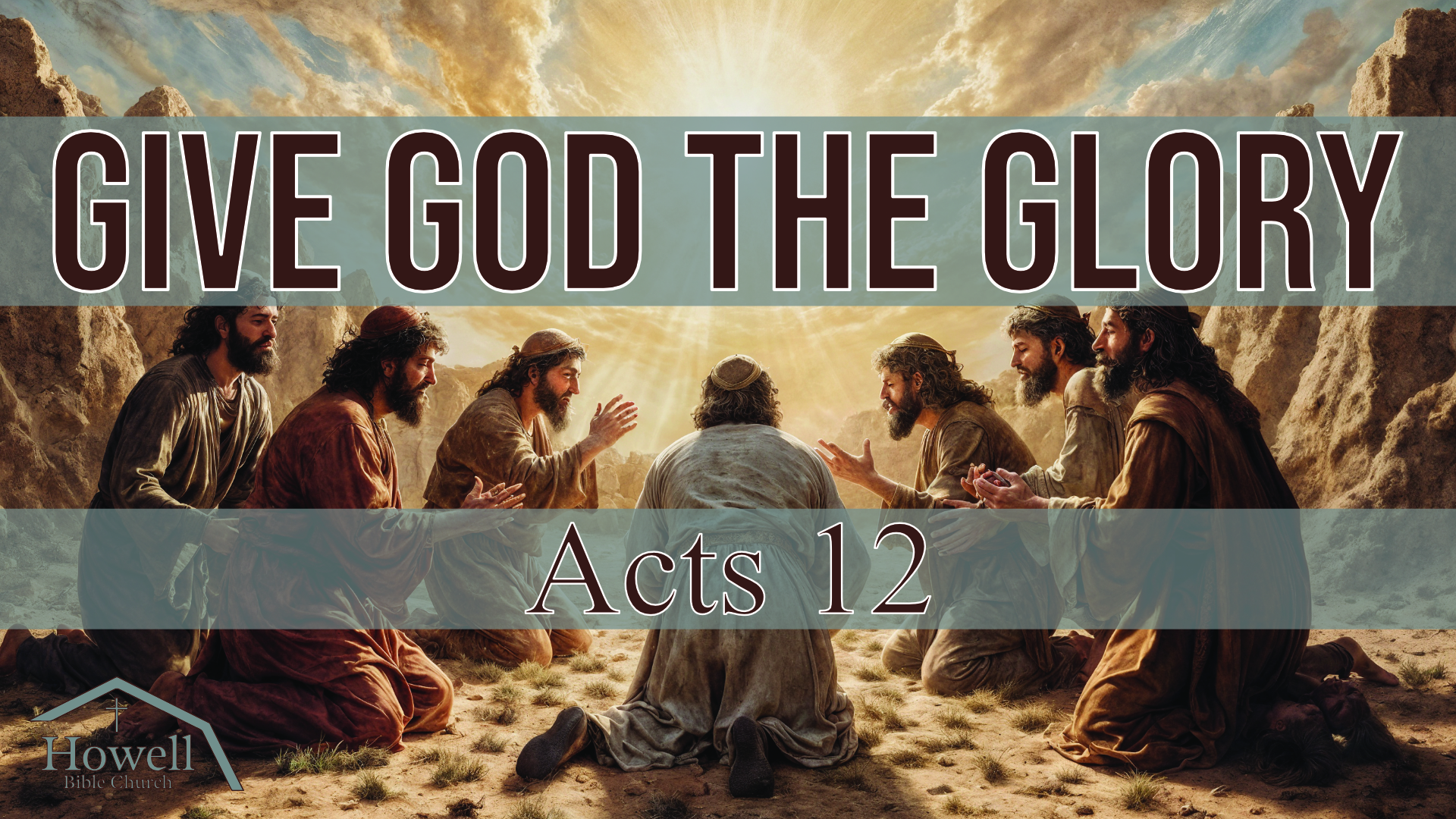
Give God the Glory

Give God the Glory: Why Faithfulness Can’t Wait for Better Circumstances

Have you heard of Quitters Day? It falls on the second Friday of January—the day when most New Year’s resolutions officially die. Statistics tell us that roughly 80% of resolutions fail by February. We’ve all been there: “I’ll start eating healthier… right after this birthday season ends.” “I’ll get serious about my spiritual disciplines… once things calm down at work.” “I’ll be more intentional about sharing my faith… when I’m in a better season of life.”

There’s a pattern here, isn’t there? We’re waiting. Waiting for circumstances to improve. Waiting for conditions to be just right. Waiting for the perfect moment to finally get more serious about following Jesus.

But what if God never designed His church to wait for favorable circumstances? What if the gospel has always advanced not when things were easy, but when God’s people were faithful regardless of what they faced?

Acts 12 confronts us with this uncomfortable reality. And it reveals something we desperately need to hear at the start of a new year.

When Everything Falls Apart

The opening verse of Acts 12 introduces us to a dark moment: “Now about that time, Herod the king laid hands on some who belonged to the church in order to mistreat them.” More than a decade has passed since Pentecost. The early church has experienced explosive growth, miraculous signs, and favor with the people. But now the tide has turned.

Verse 2 delivers the news with stunning brevity: “And he had James, the brother of John, put to death with a sword.” One sentence. That’s all Luke gives us about the first apostle to be martyred. Sometimes the Bible’s brevity isn’t meant to minimize importance — it’s meant to make us pause. This is James, one of the inner three disciples who witnessed the Transfiguration. This is James the apostle, protected through so much persecution, now executed.

And then it gets worse. When Herod saw that killing James pleased the Jewish leaders, he arrested Peter too. Remember when the early church enjoyed “favor with all the people”? That season is over. The political winds have shifted. Persecution isn’t just possible. Now, it’s popular.

If there was ever a time for the church to hunker down, regroup, and wait for things to improve, this was it.

Continue reading

Evangelism Report – 2025

When Seed-Sowing Meets Prayer: Reflections on a Year of Gospel Proclamation

How do you measure a year’s worth of evangelism? By conversions? By opportunities? By seeds planted?

This past Sunday, our evangelist stood before our congregation and delivered something we don’t often see in churches today—a comprehensive evangelism report. Not a vague commitment to “sharing Jesus more.” Not a theoretical sermon about the importance of evangelism. But an actual account of what one church family accomplished when they took the Great Commission seriously for twelve months.

As I listened to Eric recount the tens of thousands of gospel tracts distributed, the $100,000+ invested in benevolence ministry, the countless conversations on street corners and college campuses, I found myself wrestling with a tension that runs through all faithful evangelistic work: the gap between extensive sowing and visible harvest. Eric preached from Ephesians 4:11-16, and in those verses, we see both the blueprint for how evangelism should function in the church and the reminder that fruit comes from God’s power, not merely our programs.

The Evangelist’s Job Description

Eric opened by explaining his role at Howell Bible Church, drawing directly from Ephesians 4:11-16. Paul lists various officers—apostles, prophets, evangelists, pastors and teachers—and then gives their purpose: “for the equipping of the saints, for the work of service, to the building up of the body of Christ.”

This is crucial. The evangelist doesn’t do all the evangelism. The evangelist equips the saints to do evangelism. It’s the difference between hiring a missionary and becoming a missionary church. Eric emphasized this repeatedly: “We’ve done this together. This is not anything that I do by myself. It’s us doing it, not me.”

Eric referenced my book The Forgotten Officer, which explores why this office exists and how churches can recover it. That book, published in 2016, described much of the theological foundation for why we planted Howell Bible Church in 2014. From our founding, we’ve been committed to the conviction that Ephesians 4 presents a specific office within the church whose purpose is to equip the entire body for evangelistic work. This isn’t just semantics—it’s been part of our DNA from day one. Eric is our third evangelist, and he joined a church culture that already recognized and valued this office. The fruit we’re seeing this year isn’t the result of a new innovation—it’s what happens when this biblical model is lived out faithfully over time. It is Christ’s design for His church.

When Paul uses the body metaphor in Ephesians 4, he’s showing us that every part must work for the body to grow. The evangelist is one part in that body, but his effectiveness multiplies when he activates all the other parts. Eric’s year-and-four-months (so far) at HBC has continued to demonstrate this model in action. The office of evangelist isn’t about one person’s heroic efforts. It’s about systematic equipping that mobilizes an entire congregation. Together, we can do more.

Continue reading

Antioch

When the World Had No Word for What They Saw

The Christmas carol plays softly in the background: “Peace on earth, good will to men.” We’ve sung it a thousand times. We’ve written it on cards, stitched it on decorations, and repeated it like a mantra every December.

But if we’re honest, doesn’t it feel a little hollow this year?

Political tribalism tears families apart at the dinner table. Racial tensions never seem to heal. Social media echo chambers make it impossible to agree on basic facts. Christians can barely stand to be in the same room with other Christians over secondary issues. And we’re supposed to believe in peace on earth?

In 1863, the poet Henry Wadsworth Longfellow asked the same question. As the Civil War raged and his country tore itself apart, as he mourned his wife’s horrific death and tended to his wounded son, he penned the words to “I Heard the Bells on Christmas Day.” In despair, he wrote: “There is no peace on earth, I said, for hate is strong and mocks the song of peace on earth, good will to men.”

Was the angelic proclamation at Christ’s birth just beautiful poetry? Or can the promise actually be kept?

The City Where Enemies Became Family

The answer is found in an unlikely place: a bustling Roman city called Antioch, decades after Christ’s resurrection.

Acts 11 takes us back to the aftermath of Stephen’s martyrdom, when persecution scattered believers throughout the Roman Empire. Most of these early Christians did what made sense—they preached to Jews only. Stay with your people. Keep it safe. Don’t rock the boat.

But some believers from Cyprus and Cyrene did something radical. They began speaking to Greeks also, preaching the Lord Jesus. And Acts 11:21 tells us something astonishing: “The hand of the Lord was with them, and a large number who believed turned to the Lord.”

This wasn’t just intellectual assent. These people—Jews and Greeks who had every reason to hate each other—were turning to the Lord together. They were worshiping together. Living together. Becoming something the world had never seen before.

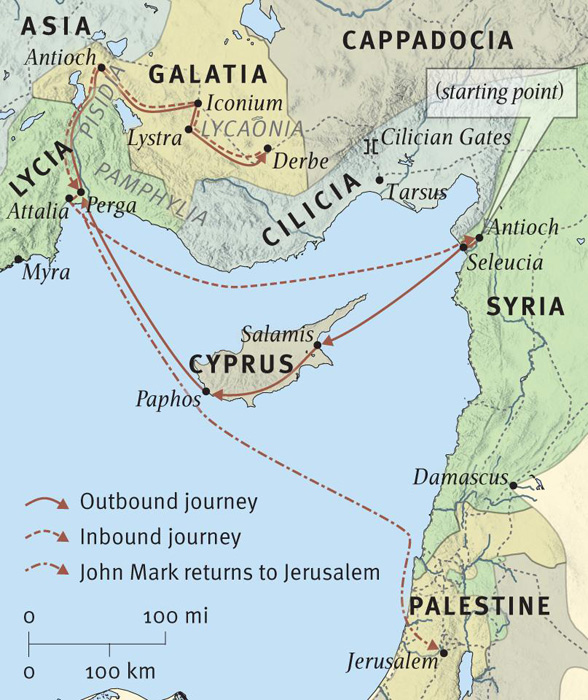
The news spread fast. So fast that the church in Jerusalem sent Barnabas on a 300-mile journey to investigate what was happening in Antioch.

Grace That Could Be Witnessed

Here’s what I love about Acts 11:23—when Barnabas arrived, he “witnessed the grace of God.”

Not felt it. Not heard about it. He could actually see it.

I’ve only experienced this a handful of times in my life. Once was in Ethiopia, visiting a tribe that just years earlier had settled their conflicts by hacking each other to death with machetes. But the gospel had come. Lives had changed. And when I arrived, I didn’t encounter violence—I encountered joy unlike anything I’d ever seen. Former enemies praying for me. Worshiping with me. Receiving me as family.

That’s what Barnabas saw in Antioch. The grace of God wasn’t just a theological concept—it was visible in the transformed lives of people who should have been enemies but had become family.

And the world noticed.

A Name for Something Never Seen Before

Acts 11:26 drops this detail almost casually: “The disciples were first called Christians in Antioch.”

We take that word for granted. But this was the moment it was invented. Up until this point, followers of Jesus were viewed as just another sect of Judaism—like the Pharisees or Sadducees, but with some different beliefs about the Messiah.

But in Antioch, something was so radically different that outsiders looked at this movement and said, “We need a new word for this.”

They didn’t call themselves Christians. The world named them that. The world looked at their worship of Christ, their commitment to the apostolic teaching, their fellowship across impossible cultural barriers, their sacrificial love for one another, and said: “You people belong to Christ. You’re Christians.”

I wonder what the world would call us today if we didn’t identify ourselves.

Continue reading

Repentance to Life

Repentance to Life: When God Opens Doors We’d Rather Keep Closed

What would you do if someone told you that revival was breaking out among the people you like the least?

About a year ago, a friend texted me to say that a genuine move of God seemed to be happening on the Ohio State football team. As a University of Michigan graduate, that rivalry runs deep—it’s not just about sports; it’s cultural identity. My first response wasn’t celebration. But when I confirmed that people were truly being saved, that the gospel was reaching even them, I had to rejoice. Despite my college loyalties, I was genuinely glad to hear that the gospel was advancing.

But here’s the uncomfortable question we all need to wrestle with: Who are the “even them” people in your life? Maybe it’s not about a football rivalry. Maybe it’s a political affiliation that makes your blood boil. Maybe it’s a lifestyle you find reprehensible. Maybe it’s just people who annoy you. We all have these categories—people we’d struggle to genuinely celebrate if we heard they came to Christ.

Acts 11:1-18 shows the early church facing this exact struggle. And here’s what’s striking: for most of us reading this as Gentiles, there was a point in history when we were the “even them” people. The door that was opening in this passage was opening for us.

When the News Travels Faster Than the Messenger

The apostles and believers throughout Judea heard that the Gentiles had received the word of God. But notice what happens next: When Peter came up to Jerusalem, those who were circumcised took issue with him. They didn’t welcome him with open arms or ask to hear the amazing testimony of what God had done. Instead, they came with an accusation: “You went to uncircumcised men and ate with them.”

To modern ears, this might not sound like much. But in their context, this was a charge of lawbreaking. Peter, a leader in the church, was being accused of violating the very law that set them apart as God’s people. The controversy had been brewing for days while Peter was still in Caesarea, and by the time he returned home, instead of rest, he walked into an interrogation.

Imagine witnessing one of the most significant moves of God in history—the Holy Spirit falling on Gentiles just as He fell on the Jewish believers at Pentecost—and receiving immediate criticism from your own church family as your reward.

Continue reading

Lord of All


When the World is More Eager Than the Church

Have you ever noticed how sometimes the people we assume aren’t interested in God turn out to be the most spiritually hungry? We make excuses—”If they wanted to know about God, they’d come to church” or “The information is out there; it’s in their court now.” But what if our assumptions are wrong? What if the world is actually more eager to receive the gospel than we are to proclaim it?

That’s exactly what we discover in Acts 10, one of the most pivotal chapters in human history. This is the moment when God officially opens the door for the gospel to go to the Gentile world. Without this door swinging wide open, the gospel never would have reached people like us. But here’s the striking reality in this passage: Cornelius the centurion was far more ready to hear about Jesus than Peter was to tell him.

This passage confronts us with an uncomfortable truth about our own hesitancy to cross barriers, our reluctance to share what we’ve freely received, and our tendency to underestimate how hungry people really are for the truth.

The Eager Seeker Who Had Everything but Jesus

Cornelius wasn’t your average Roman centurion. Scripture paints a picture of a man who was devout, prayerful, generous, and God-fearing. He gave alms to the Jewish people. He prayed continually. He had drawn as near to the God of Israel as a Gentile could without becoming a full convert. By all appearances, this was a deeply spiritual man.

But here’s what we must understand: sincerity is not enough for salvation. Interest in spiritual things is not enough. Even having a god that you worship is not enough. Cornelius needed to hear about Jesus. He needed the gospel. Without it, despite all his devotion and good works, his sins remained unforgiven.

God knew this. So He sent an angel to appear to Cornelius with very specific instructions: “Send to Joppa and ask for Simon, who is also called Peter. Bring him here.” And what did Cornelius do? He immediately obeyed. He sent his servants. And then, while he waited for this preacher to arrive, he gathered everyone he could—his relatives, his close friends, his household—and said, “You need to hear this message too.”

Imagine that kind of spiritual hunger. Cornelius didn’t even know what message he was going to hear, but he filled his house with people to listen.

The Reluctant Messenger Who Said “No, Lord”

Meanwhile, Peter was on a rooftop, praying and physically hungry. And that’s when God gave him a vision—a dramatic, repeated, impossible-to-ignore vision. A sheet came down from heaven filled with all kinds of animals, and a voice said, “Get up, Peter, kill and eat.”

Peter’s response? “By no means, Lord, for I have never eaten anything unholy and unclean.”

Let that sink in. Peter said “No” to the Lord. And God had to repeat this vision three times before Peter would even begin to consider what God was showing him. Jesus had already declared all foods clean back in Mark 7, but Peter was still clinging to his traditions, his upbringing, his comfort zone.

This wasn’t really about food, though. The food laws had been given to make Israel a separate, distinct people—set apart for God’s purposes. But now that the Messiah had come, those barriers were being torn down. God was saying, “What I have called clean, no longer call unclean.” And He wasn’t just talking about bacon and shellfish. He was talking about people.

Even after the vision, Peter was confused. But then—perfectly orchestrated by God—the men sent by Cornelius arrived at his door. The Spirit spoke to Peter: “Go with them without misgivings, for I have sent them myself.”

Continue reading

Peter’s Healing Ministry

When God’s Power Does the Heavy Lifting: Reflections on Peter’s Healing Ministry

Have you ever walked away from a conversation about faith feeling like a failure? You stumbled over your words. You couldn’t remember that perfect response you’d rehearsed. The person walked away unconvinced, and you were left wondering if you’d done more harm than good.

If that’s ever been you, this past Sunday’s message was exactly what you needed to hear.

Evangelist Eric Love continued our journey through the book of Acts, bringing us to chapter 9, verses 32-43. What unfolded wasn’t just a lesson in biblical history—it was a recalibration of how we think about our role in sharing the gospel.

The Church Was Born for Mission

Eric opened by reminding us of the big picture. The book of Acts records the explosive growth of the early church in the thirty years following Christ’s resurrection. And Acts 1:8 serves as the thesis statement for everything that follows: “You will receive power when the Holy Spirit has come upon you, and you shall be My witnesses in Jerusalem, in all Judea and Samaria, and to the ends of the earth.”

Here’s what struck me: those words were spoken directly to the apostles, yet they were fulfilled by the entire church. When persecution scattered believers throughout Judea, Galilee, and Samaria, it wasn’t just the apostles preaching. Ordinary Christians carried the gospel wherever they went, planting churches and seeing thousands come to faith.

The Great Commission wasn’t meant for a select few. It belongs to all of us.

No Magic Tricks Here

In Lydda, Peter encountered a man named Aeneas who had been paralyzed and bedridden for eight years. Eric made an important observation: the miracles recorded in Scripture weren’t cheap illusions performed for gullible crowds. These were verifiable, severe conditions healed instantly and publicly.

You can’t fake blindness from birth. You can’t pretend to be lame for a lifetime.

Jesus healed a man born blind in John 9. Peter had previously healed a man lame from his mother’s womb in Acts 3. And now, Aeneas—eight years paralyzed—rises immediately at Peter’s word. These weren’t pulled rabbits or guessed cards. These were undeniable acts of God performed in plain sight, leaving witnesses with only one conclusion: this power comes from somewhere beyond human ability.

Continue reading

A Chosen Instrument


A Chosen Instrument

Reflections on Acts 9:1-31

Everyone was afraid of him.

That’s the situation in Acts 9:26. Saul of Tarsus — the man who had been breathing out threats and murder against the church, the man who had dragged men and women off to prison, the man who had cast his vote against Christians when they were being put to death — this man shows up in Jerusalem claiming to be a disciple. And believers are skeptical of him.

Can you blame them? This wasn’t just someone with a rough past. This was the greatest enemy the early church had ever known. His reputation preceded him by hundreds of miles. When Ananias in Damascus received a vision telling him to go to Saul, his immediate response was essentially, “Lord, are you sure? I’ve heard about this guy” (Acts 9:13-14).

So, when Saul arrives in Jerusalem wanting to associate with the disciples, the fear is understandable. The hesitation makes sense. But if that’s where the story ended — if everyone had simply kept their distance — the history of the church would look very different.

Enter Barnabas.

The Man Who Stepped Forward

Verse 27 tells us that Barnabas “took hold of him and brought him to the apostles.” While everyone else hung back, one man stepped forward. He vouched for Saul. He explained how Saul had seen the Lord on the road, how Jesus had spoken to him, how he had been preaching boldly in Damascus.

Here’s what makes Barnabas’s action so remarkable: unlike Ananias, Barnabas didn’t receive a divine vision commanding him to do this. No angel appeared. No voice from heaven. He simply saw what God had done in Saul’s life and had the courage to act on it.

This is the Barnabas moment — and it’s a moment the church still needs today.

Continue reading

The Mission Continues

The Mission Continues: When God Orchestrates Divine Appointments

Have you ever experienced a moment so perfectly timed that you couldn’t help but see God’s hand in it? A conversation that started exactly when someone needed to hear truth? A question asked just as you had the answer?

We live in a hyper-connected world where information travels instantly, yet countless people around us have never truly heard the gospel. Despite Bibles on every shelf, sermons streaming online, and churches on every corner, there are neighbors in our own county who don’t know Jesus Christ. If this was true in our digital age, imagine the early church—no internet, no printing press, no mass communication—yet the gospel spread like wildfire.

How did they do it? Acts 8:25-40 reveals a pattern that’s as relevant today as it was 2,000 years ago.

From Revival to the Road

Peter and John had just witnessed an incredible move of God among the Samaritans. After confirming that Philip’s ministry was genuine and that the Holy Spirit was truly at work, they headed back to Jerusalem. But they didn’t waste the journey—they preached the gospel to many Samaritan villages along the way.

This wasn’t casual conversation. The text says they “solemnly testified and spoke the word of the Lord.” That phrase carries weight. This wasn’t feel-good, surface-level talk. They understood they were speaking about matters of eternal life and death. The gospel is good news precisely because, without it, we remain under God’s wrath. That’s a heavy testimony, and they treated it with the seriousness it deserved.

Meanwhile, Philip continued his ministry. But God had other plans—plans that would take him from revival crowds to a single conversation on a desert road.

Continue reading

The Gift of God


The Gift of God – Acts 8:5-24 | Howell Bible Church


The Gift of God

Have you ever avoided someone because bridging that gap just seemed too difficult? Maybe it’s a coworker with opposing political views, a neighbor from a different background, or even a family member you’ve written off as “too far gone.” We all have people or places we’d rather avoid.

But what if God is calling you to cross that barrier?

In Acts 8, we witness one of the most dramatic cultural crossings in the early church. Philip, a Jewish believer fleeing persecution in Jerusalem, does the unthinkable: he goes to Samaria and preaches Christ. To grasp the weight of this moment, you need to understand that Jews and Samaritans despised each other with a hatred spanning centuries. Jews would literally travel miles out of their way to avoid passing through Samaritan territory. These weren’t just unfriendly neighbors—they were considered half-breeds, religious heretics, enemies.

Yet Philip goes. And when he does, something extraordinary happens.

When God’s Power Crosses Human Barriers

Philip didn’t sneak into Samaria to hide. He proclaimed Christ openly, and the crowds gave attention to what he said as they heard and saw the signs he was performing. Demons were cast out with loud shouts. The paralyzed walked. The lame were healed. The text tells us there was “much rejoicing in that city.”

Picture that scene for a moment. A Jewish preacher proclaiming a Jewish Messiah to a people who had been taught to hate Jews—and instead of rejection, there’s citywide celebration. This is the power of the gospel to demolish walls many thought were permanent.

Philip’s message was simple but profound: he preached the Kingdom of God and the name of Jesus Christ. He wasn’t offering self-help tips or cultural commentary. He was proclaiming that the long-awaited King had come, that His name was Jesus, and that anyone—even despised Samaritans—could enter His kingdom through repentance and faith.

Men and women believed. They were baptized. They publicly identified with this King and His kingdom. The barrier that had stood for generations crumbled in the face of resurrection power.

Continue reading